Floral Butterfly and Moon Phases SVG
A Quietly Spellbinding Line Art Design — Tested on a Linen Tote Bag
I recently pulled the Floral Butterfly and Moon Phases SVG into my embroidery workflow to test it for a client’s custom linen tote bag—intended as a boutique gift for a local apothecary shop. No flashy launch, no influencer campaign—just real fabric, real thread, and real expectations. What struck me first wasn’t its “boho” label or celestial buzzwords, but how calmly it holds space: delicate yet legible, intricate but not fussy, mystical without tipping into clutter. It’s line art that breathes—and that matters more than you’d think when translating from screen to stitch.Mood & Movement: Why This Design Feels Handmade, Not Mass-Produced
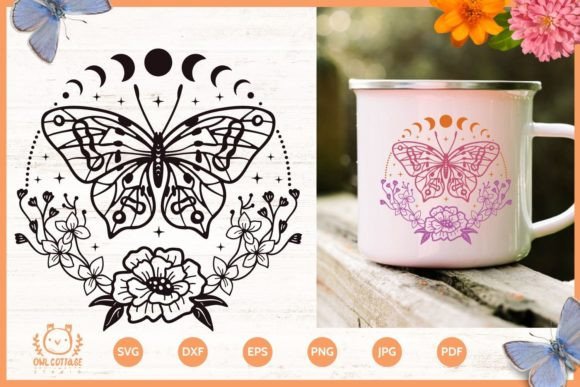
The Floral Butterfly and Moon Phases SVG leans into soft asymmetry. The butterfly isn’t centered; it drifts slightly left, wings cradling three crescent moon phases stacked like quiet punctuation. Tiny florals curl at the base—not filler, but grounding. There’s no heavy fill stitch, no dense satin borders—just clean running and outline strokes. That makes it inherently friendly for embroidery: low stitch density, minimal underlay, and generous negative space. For small shop owners stitching on tight deadlines, that translates to faster hooping, fewer thread breaks, and smoother transitions between fabric types.Where It Shines (and Where It Asks for Thought)
This design excels in projects where subtlety reads as intention—not noise. I stitched it on a natural linen tote using 40-weight cotton thread in charcoal gray. On that textured surface, the fine lines stayed crisp, and the open layout let the fabric’s weave peek through just enough to reinforce the handmade feel. It also worked beautifully as a sweatshirt embroidery—placed off-center on the chest—because the composition doesn’t demand symmetry to read clearly.
For baby embroidery? Yes—but with caveats. The moon phases are distinct enough for nursery decor (think pillow covers or tea towels), but avoid placing it near seams or elastic hems where distortion could blur the delicate arcs. On stretchy fabric like jersey tees? Use light cutaway stabilizer and reduce top tension slightly—those thin lines don’t forgive puckering.
As a patch design? Strong candidate. Its self-contained shape and moderate scale (roughly 3.5" wide at default proportions) hold up well when heat-applied or sewn on. For caps or curved surfaces? Test first. The uppermost moon phase sits close to the top edge—if your hoop can’t clear the bill’s curve, consider simplifying that element manually or repositioning lower.
What Customers Actually Notice (and Why It Matters)
When I showed the finished tote to five customers browsing the apothecary, four paused mid-step. Not because it screamed for attention—but because it invited looking closer. That’s rare. Most T-Shirt Designs lean hard into boldness; this one earns engagement through quiet cohesion. People commented on the “calm balance,” the “soft magic,” even the “thoughtful spacing.” That kind of reaction builds trust—not just in the product, but in your eye as a designer or seller.
That matters for Etsy sellers and craft fair vendors. A design like the Floral Butterfly and Moon Phases SVG supports brand consistency across listings: pair it with sage-dyed fabrics, matte ceramic mugs, or minimalist packaging, and it feels intentional—not slapped on. It also elevates perceived value. A $28 embroidered tea towel feels like a curated gift, not a craft supply leftover, especially when the stitch work honors the original line art’s delicacy.
Practical Notes Every Embroidery Designer Should Check
- Test on scrap first—especially if using textured or dark fabric. Linen, canvas, and medium-weight cotton all handled it well; lightweight rayon did not.
- Thread color contrast is non-negotiable. On black fabric, use bright white or metallic silver. On ecru or oat, try deep indigo or forest green—not beige or cream.
- Review stitch density before digitizing. Though the SVG is clean, some auto-digitizers overfill small moon curves. Keep those as running or satin outlines only.
- Hoop size matters more than you think. At full scale, it fits comfortably in a 4x4 hoop—but shrink it below 2.75", and the inner moon details risk disappearing in thread.
- Stabilizer choice changes everything. Tear-away works for stable fabrics like denim or duck cloth; cutaway is safer for knits or anything destined for frequent washing.
- Check licensing before selling finished items. The listing says “Celestial and Mystical SVG designs to add to your next crafting projects”—but verify whether commercial use (e.g., selling embroidered patches on Etsy) is explicitly permitted.
- Mock it in grayscale. If the design loses hierarchy or legibility without color, simplify before stitching.
Final Thought: It’s Not Just a Graphic—It’s a Tone Setter
The Floral Butterfly and Moon Phases SVG isn’t built for loud statement pieces. It’s for the quiet confidence of a handmade product that feels considered down to the last stitch. It suits small business owners who curate rather than crowd, crafters who value clarity over complication, and designers who know that restraint often lands harder than repetition.
If you’re choosing embroidery file assets for a holiday collection, a baby line, or a boutique capsule—this one earns its place not because it’s trendy, but because it stitches true, reads well, and invites care at every step. Just remember: respect its quietness. Give it the right stabilizer, the right thread, the right fabric—and it’ll return the favor in finished product appeal, customer resonance, and that intangible glow of thoughtful making.